Growing in Christ Is Not Like Leveling Up
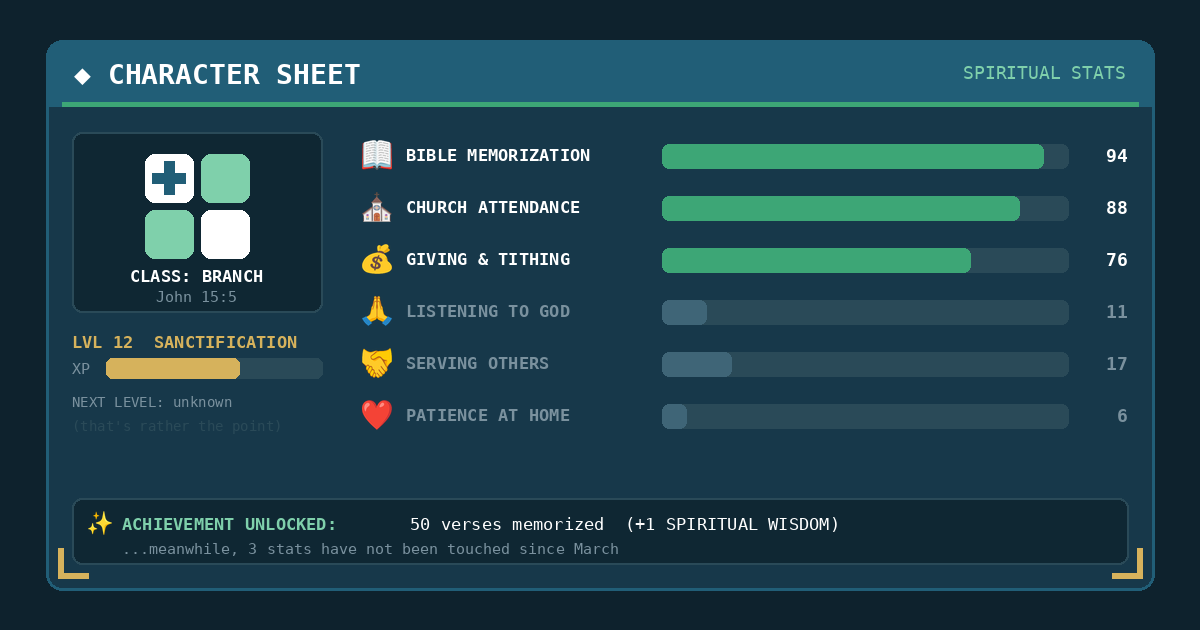
I’d like it if growing in Christ worked like an RPG. Memorize fifty verses, +1 to Spiritual Wisdom. Attend an extra church service, +1 to Church Attendance. Volunteer at a homeless shelter, +1 to Christian Service. A little chime, a progress bar, maybe a notification telling me I’ve reached Level 12 Sanctification and unlocked Patience.
I’m not being entirely flippant. I think there’s genuine value in gamifying progress, and I’ve thought for years that someone should do this well. Maybe that kind of linear progression is how we’ll mature in heaven — steady, permanent, no backsliding. But here on earth, we stumble.
Prefer to watch? Here’s the 60-second version:
Three Reasons the Progress Bar Doesn’t Work Here
The first is that growth isn’t linear. We get more Christlike in one area and quietly neglect another. Someone who has just conquered a temper can discover, six months later, that they’ve become impatient in a completely different direction. The bar goes up in one place and down somewhere you weren’t watching.
This happens constantly, in everybody’s life and certainly in mine. We get twenty-four hours, and whatever we’ve most recently decided is important takes them. When I get serious about fitness, that’s what I focus on and what I measure — tracking workouts, watching what I eat, feeling genuinely good about myself. Meanwhile I’m going to bed later than I should to fit it all in, work is getting whatever’s left over, and my time with God has quietly become whatever fits in the gaps. Then a project at work heats up and the fitness slides, which is fine, I tell myself, I’ll get back to it. Then somewhere in there I notice I haven’t called a friend in three months, or that I’ve been physically present with my family while my mind was clearly somewhere else, or that I haven’t served anybody outside my own household since… I’m honestly not sure when.
And here’s the part that fooled me for years. Because I’m always working hard on at least one area, I always feel like I’m getting better. There’s always a chart going up somewhere. But if the improvements are just taking turns, and each one is funded by neglecting something else, that’s the illusion of progress rather than the thing itself. Real growth would be the whole life moving, roughly together, in the direction God actually cares about — and it took me an embarrassingly long time to notice the difference.
If the improvements are just taking turns, that’s the illusion of progress rather than the thing itself.
The second reason is that new strength attracts attention. Satan often attacks us right where we’ve just grown, because that’s exactly where we’ve started to get arrogant. Paul saw this plainly enough to warn about it: “if you think you are standing firm, be careful that you don’t fall” (1 Corinthians 10:12 NIV). The area you’d list as your strongest is probably the area where you’re least on guard, which is an uncomfortable thing to sit with for a minute.
The third one is the practical problem. We only have so many hours in our lives to spend glorifying God, and unbalanced gamification would push us to spend them wherever the points are easiest to earn. If memorization gives me a visible number and quiet listening doesn’t, I’ll memorize three more verses and skip the listening. Not because I decided listening matters less. Because the scoreboard told me where to go.
And the Deeper Problem
Here’s the one that actually worries me. Stat-tracking of that kind can quietly turn the whole thing inward. My numbers, my progress, my growth, my badges. We’re already too self-absorbed — I certainly am — and a system that measures my spiritual performance would feed that rather than starve it.
Which is the opposite of the point. As we abide in Christ, we should be listening to the Holy Spirit about where He wants our attention, and that changes. Some weeks He points at something I’d never have chosen from a menu. A leaderboard would have had me grinding away at whatever I was already good at.
But I Still Want to Gamify It
I’m not letting go of this entirely, because I don’t think the instinct is wrong — just the implementation.
A system that worked would let people set their own goals based on how the Spirit is leading them, and change those goals as they’re led. It would always point upward and outward, toward God and toward other people, so it never becomes a mirror. No public leaderboards, ever. If badges exist at all, they get shared with an accountability partner and nobody else. Prayer, service, fasting, memorization, time in the Word, abiding — those are worth noticing, but privately, and among people who know you.
The most useful version wouldn’t rank you at all. It would just notice things. It would keep track of areas you said mattered and haven’t touched in a while — areas of opportunity, not failures. And it would flag where you’re pouring enormous energy and gently ask whether that’s genuinely where you feel led, or just where you’re comfortable.
What I Actually Built
Full disclosure: the God OS app has a streak counter. I put it there on purpose, and I’ve thought about whether it belongs.
Here’s why I kept it. The streak doesn’t measure your spiritual level, your growth, or how you’re doing. It measures one thing: did you show up? That’s the Meaningful Minimum made visible, and showing up is the only thing on the list that’s genuinely mine to do — the growing is His work. Miss a day and it doesn’t scold you; it’s just glad when you’re back.
The other piece is the Walk Plan, which is closer to what I described above. Once a season you write down what you’re actually committed to, including the areas you keep meaning to get to. Then your daily focus comes out of that instead of out of whatever’s easiest to measure. It’s not points. It’s a page that remembers what you said mattered, which turns out to be more useful.
What I’m Doing Instead
This is what I’m trying to do now, and it’s the entire premise God OS is built on: listening to God and following Him, in Worship, Word, and Walk. It’s the difference between religion and relationship — between trying to please God in my own strength and leaning on His mercy, His grace, and His strength.
Worship is where it starts, because the first commandment is still the first one: “Love the Lord your God with all your heart and with all your soul and with all your mind” (Matthew 22:37 NIV). Not measure your love. Love Him.
The Word is where He does the sorting I can’t do for myself — “it penetrates even to dividing soul and spirit, joints and marrow; it judges the thoughts and attitudes of the heart” (Hebrews 4:12 NIV). A scoreboard tells me how I’m doing by my own metric. Scripture tells me what’s actually going on in me, which is a different service entirely.
The Walk turns the whole thing outward, which is the safeguard against the self-absorption I was worried about: “Love your neighbor as yourself” (Matthew 22:39 NIV).
And all of it runs on Him, not on me: “I am the vine; you are the branches. If you remain in me and I in you, you will bear much fruit; apart from me you can do nothing” (John 15:5 NIV).
Press On
Paul had the healthiest version of this that I know of. He said plainly that he hadn’t arrived and wasn’t perfect yet, and then: “forgetting what is behind and straining toward what is ahead, I press on” (Philippians 3:13-14 NIV). No level. No score. A direction, and a decision to keep walking it.
Growth is real, and God is doing it. It just doesn’t come with a progress bar, and I’ve made my peace with that — mostly.
Discover more from God Operating System
Subscribe to get the latest posts sent to your email.